OLQs Explained: All 15 Officer Like Qualities SSB Assesses
You already tried memorizing this list once
Every aspirant does it. You write the 15 OLQs on a chart, stick it above your study table, revise the names the night before your first Board. Then Day 2 arrives — WAT sheet in front of you, fifteen seconds a word — and every trait you memorized quietly disappears. That's not bad luck. It's exactly what SSB is designed to expose: a list you can recite tells the assessor nothing. A list you actually live under pressure tells them everything.
This is the real reason so many first-attempt candidates walk out of Conference Room feeling like they "did fine" and still don't get the nod. They prepared answers. The board wasn't checking answers — it was checking whether the same person showed up in the GD, the Command Task, and the interview, three days apart, without a script.
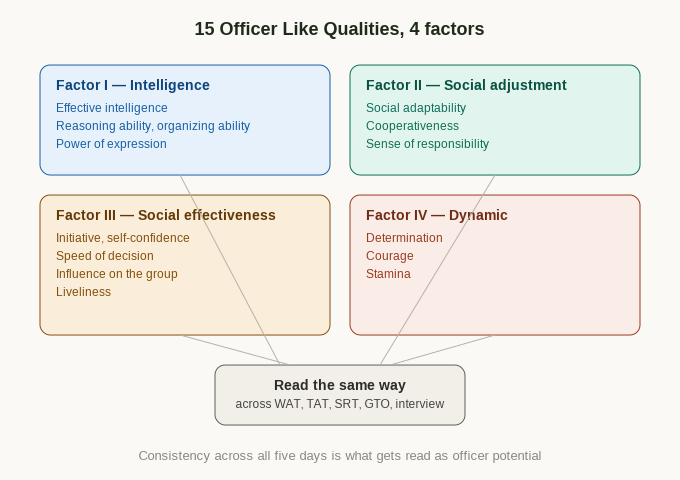
The 15 qualities, grouped the way assessors actually read them
The 15 OLQs sit in four factors. This grouping matters more than the individual names, because each factor tends to surface in a different part of the five days.
Factor I — Intelligence. Effective intelligence, reasoning ability, organizing ability, power of expression. You'll see this tested hardest in your PPDT story and your Lecturette — not because you need to sound clever, but because a clear plan communicated simply is what the board is actually listening for.
Factor II — Social adjustment. Social adaptability, cooperativeness, sense of responsibility. This is the quiet one. Nobody notices it when it's present — they only notice when it's missing, like the candidate who talks over everyone in GD or the one who vanishes when the group needs a decision.
Factor III — Social effectiveness. Initiative, self-confidence, speed of decision, ability to influence the group, liveliness. This is where most Indian aspirants underperform — not from lack of ability, but from years of being taught that speaking up without being asked is disrespectful. SSB rewards exactly the instinct your schooling may have trained out of you.
Factor IV — Dynamic factors. Determination, courage, stamina. Individual Obstacles and Command Task exist almost entirely to surface these three. This is also the factor most damaged by exam-only prep — the body that's spent two years in a coaching chair isn't automatically ready for a five-day physical and mental grind.
Why the same 60 seconds looks different for a village boy and a city boy
If you've grown up in a smaller town, chances are you were taught silence is safety — don't draw attention, don't argue with elders, let the group decide. If you've grown up in a metro with English-medium schooling, you might carry the opposite problem — confidence that reads as dominance instead of leadership, because nobody ever told you influence isn't volume.
Neither background is wrong. But SSB doesn't grade your background — it grades what you do with sixty seconds when a Command Task stalls and someone has to move first. That's the entire test compressed into one moment: will Initiative show up, or will the years of conditioning win.
The pattern that actually gets you recommended
Assessors aren't hunting for a perfect candidate who nails every OLQ equally. They're hunting for a consistent one. A candidate who shows moderate Initiative in the WAT, moderate Initiative in the GTO task, and moderate Initiative in the interview reads as authentic. A candidate who writes bold, decisive WAT responses and then goes silent in every group task reads as performed — and performed doesn't survive three days of independent observation from three different assessors.
This is the single hardest thing to self-correct without outside eyes on your own patterns. You can't feel your own inconsistency from the inside — the WAT feels fine while you're writing it, the GTO task feels fine while you're in it. It's only when someone lays your attempts side by side that the gap between your "test personality" and your "task personality" becomes obvious.
What to actually do with this today
Stop treating WAT, TAT, SRT, and GTO as four separate hurdles to clear. Start asking one question after every practice attempt: which of the 15 OLQs did I actually demonstrate here, and would the same trait show up if I did this task again tomorrow, tired, in a different mood?
If your answer is uncertain, that uncertainty is the work. Attempt a full psychology set under real time pressure, get an honest read on which OLQs are showing up and which are missing, and repeat until the gap closes. Not once — across enough attempts that a real pattern, not a lucky day, starts showing.
That's the difference between an aspirant who's memorized 15 words and an officer whose 15 qualities are already visible, whether anyone's watching or not.
Try a free WAT now — no login 20 words, 15 seconds each, about 5 minutes. Write the first thought each word brings. Start the free WAT